Thursday, June 25, 2015

New Experiences and Education with Aquatic Invasive Species By Jason

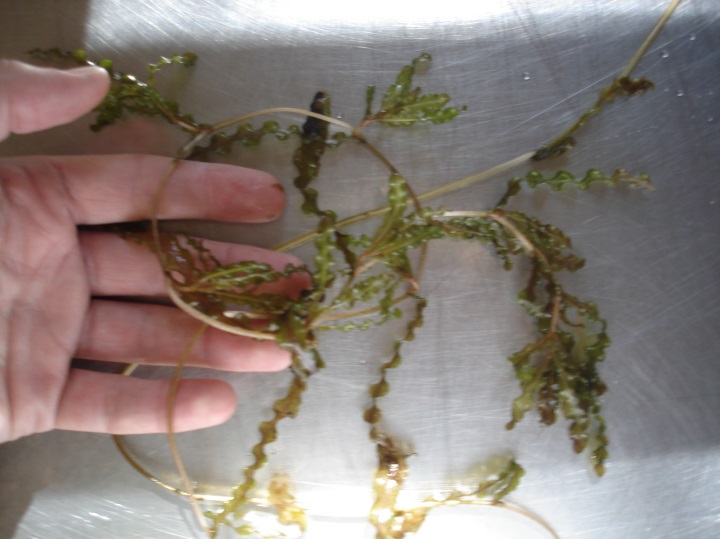
Figure 1: Curly Leaf Pondweed
My name is Jason Tutkowski and I am proud to say that this summer I am a water resources/aquatic invasive species intern at the North Lakeland Discovery Center in Manitowish Waters, WI.  In the past I have mainly worked with terrestrial invasive species such as teasel, sweet clover, and buckthorn, so I am very pleased to have the entire summer to learn about aquatic invasive species (AIS).  Invasive species are plants or animals that are not native to an area and have a propensity to spread and degrade the natural environment and human economy/health.  Heavy-hitters in the lakes and streams of the Northwoods include curly leaf pondweed, Eurasian water milfoil, purple loosestrife, banded mystery snail, Chinese mystery snail, and rusty crayfish.  My main focus this summer will be on Harris Lake and Hiawatha Lake in the Winchester area.  I will be working independently as well as with the Winchester Town Lakes Committee and volunteers to locate, document, and provide educational outreach for prominent invasive species such as curly leaf pondweed (Figure 1), Eurasian water milfoil, and purple loosestrife. 
Figure 2: Rice Creek (looking south from County Hwy K)
My search for AIS began on a recent kayaking trip to Rice Creek (Figure 2) with Maggie and Brad – two other water interns at the Discovery Center – as well as our supervisor Anne Kretschmann.  It was during that trip that I had my first look at curly leaf pondweed in the wild.  We threw our plant rake into the water and pulled up a big clump of the stuff.  The leaves of curly leaf pondweed look like thin lasagna noodles which are crisp to the touch and have serrated margins.  Those spiky edges are a key feature which differentiates it from clasping leaf pondweed, its native lookalike. 


Figure 3: Curly Leaf Pondweed Turion
So, why exactly is it a problem?  Well, it’s one of the first aquatic plants to grow in the spring and spreads rapidly through turions- specialized overwintering buds produced by aquatic plants (Figure 3), so it out-competes native plants.  It can also grow horizontally along the surface of the water which blocks light for other aquatic species and makes boating and fishing more difficult.  Then when it dies in mid-summer the decomposing plants sap dissolved oxygen from the water and also increase phosphorus causing algal blooms.  All of those deleterious effects are why it is so important to prevent the spread of curly leaf pondweed!  One of the best things people can do is to inspect and wash their boats and equipment before moving between lakes and streams.  Check out http://dnr.wi.gov/topic/invasives/ for more information on invasive species.

Monday, June 22, 2015

Symbolism, Symbolism Everywhere! By Maggie

Human culture is obsessed with assigning a meaning, idea, characteristic, prophecy or fortune to anything and everything. Flowers can have a secret meaning, the month of your birth highlights specific traits, and a cup of tea reveals your future. As for insects, some species have been present long enough to catch that attention.

A dragonfly can represent many ideas and characteristics. For the most part, this insect is used to personify a maturity of character, power, poise, awareness of the moment and defeat of self-doubt.

Japanese culture takes these positive traits a step further by associating dragonflies with victory in battle. Samurais also believed dragonflies to represent agility and power. The Chinese culture believes that dragonflies bring good luck, prosperity and harmony.

Some Native American traditions take dragonflies as a sign of speed, happiness and purity. When included in a totem, it is used to depict wisdom and change.

A few other cultures have less rosy outlooks towards dragonflies, however. Some European countries have nicknamed dragonflies ‘Devil’s Needle’, ‘Ear Cutter’ and ‘Horse Stinger’. In ye old time of witches and dark magic, it is believed that these names were created due to misconceptions and superstition.

For example, ‘Horse Stinger’ came about because people noticed horses stamping their feet when dragonflies were nearby. The assumption was the insects were upsetting the horses by biting and/or stinging them. With current knowledge about the insects’ habits, it is strongly believed that the dragonflies were actually assisting the horses by consuming the bugs doing the stinging. 

So much meaning and history for one small insect!

Currently, it is the mating season for dragonflies. The inevitable population boom will occur in late summer, specifically late July. But for those that wish to be blessed with good luck and grounded in the moment, dragonflies are plentiful at the water’s edge. If you visit Statehouse Lake on a sunny afternoon, try sitting still at the end of the dock. You’ll have plenty of visitors!


Monday, June 1, 2015

Teaching to Inspire By Emily Anna

I never wanted to be a teacher.  Even with my mom, a teacher herself, constantly telling me I was a natural at it, it wasn’t what I saw myself doing.  I had no desire to sit in a classroom all day, grade papers, or write up report cards.  I was passionate about the environment and conservation, so teaching just didn’t fit into the picture I had drawn up for my life.
                When I received an email offering me an interview for the position of Environmental Education Intern at the Discovery Center, I have to admit I was hesitant.  To protect and be a steward for the environment I have to do research, I kept telling myself.  So, after pondering it for a few minutes I thought, why not, it will be good practice interviewing at the very least. 
                The interview with Licia and Heather was phenomenal!  They made me feel so comfortable; it was like talking to a couple of old friends.  Suddenly, I was feeling really excited about a job that I had initially not even been interested in.  I began researching the Discovery Center and the more I learned, the more excited I became.  The Center is located in a beautiful area not too far from where I was living in Marquette; the mission aligned with my values, and unlike other jobs I had been offered, it provided a place to live!  I was ecstatic when I got a call from Licia the next morning offering me the job, and I accepted in on the spot.

                After spending a few days settling in and getting to know the staff, it was time for school programs.  I got my first taste of what environmental education was all about, and I loved it.  I shadowed Licia while she taught macro invertebrates and underworld classes to North Lakeland School second graders and took notes on literally every word she said.  The excitement that the kids had and eagerness to learn just energized me!  I called my mom that night to tell her how natural teaching came to me and how good it made me feel.  She didn’t say it out loud, but I’m sure an “I told you so” was floating around in her mind.
The following week I agreed to teach reptile and amphibian classes to first graders.  I couldn’t have asked for it to go any better.  I was able to show them all of the awesome critters we have in the Nature Nook, so their excitement was through the roof.  Myrtle, the ornate box turtle, was of course the show stopper. Again I kept thinking to myself, maybe research isn’t the only way to protect the environment. 
The next day we planned to take the Mercer 1st-6th graders to Van Vliet Hemlocks for some programs.  The evening before the programs we went to go scope it out, and the mosquitos were unbearable!  Even with a thick coat of bug spray covering my entire body, they were biting my eyes, ears, and fingertips.  We knew that if we were going crazy because of them, there was no way the kids would have any fun.  So, I found out very last minute that I would be teaching the macroinvertebrate class on my own back at the Discovery Center.  I had seen Licia do it and helped out several times by then, but I was still nervous.  This wasn’t just second graders anymore, it was first through sixth graders, and that intimidated me.  However, the day ended up being so much fun!  As soon as I started teaching I stopped thinking and everything came so naturally.  The kids were so interested in everything and could have dug through the muck looking for critters all day if I would have let them.  
As much as I never thought I would be a teacher, my first few weeks here at the Discovery Center are making me question everything I thought I would do with my career.  I have loved having the opportunity to teach, and it feels truly rewarding.  You get these kids out in the dirt and muck and you see a side of them that has possibly never been brought out before.  I feel invigorated and energized watching them truly engage and learn, and have an incredible time while doing it.  I’ve always thought research was the best way to protect and conserve our environment, but I’m learning that it’s not the only way.  These kids are the future of our planet and if we don’t get them outside and excited about nature, then who will?