Thursday, June 25, 2015

New Experiences and Education with Aquatic Invasive Species By Jason

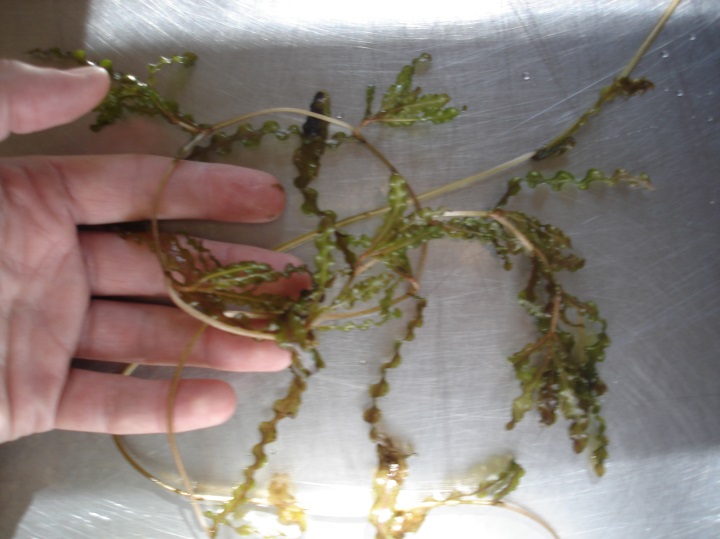
Figure 1: Curly Leaf Pondweed
My name is Jason Tutkowski and I am proud to say that this summer I am a water resources/aquatic invasive species intern at the North Lakeland Discovery Center in Manitowish Waters, WI.  In the past I have mainly worked with terrestrial invasive species such as teasel, sweet clover, and buckthorn, so I am very pleased to have the entire summer to learn about aquatic invasive species (AIS).  Invasive species are plants or animals that are not native to an area and have a propensity to spread and degrade the natural environment and human economy/health.  Heavy-hitters in the lakes and streams of the Northwoods include curly leaf pondweed, Eurasian water milfoil, purple loosestrife, banded mystery snail, Chinese mystery snail, and rusty crayfish.  My main focus this summer will be on Harris Lake and Hiawatha Lake in the Winchester area.  I will be working independently as well as with the Winchester Town Lakes Committee and volunteers to locate, document, and provide educational outreach for prominent invasive species such as curly leaf pondweed (Figure 1), Eurasian water milfoil, and purple loosestrife. 
Figure 2: Rice Creek (looking south from County Hwy K)
My search for AIS began on a recent kayaking trip to Rice Creek (Figure 2) with Maggie and Brad – two other water interns at the Discovery Center – as well as our supervisor Anne Kretschmann.  It was during that trip that I had my first look at curly leaf pondweed in the wild.  We threw our plant rake into the water and pulled up a big clump of the stuff.  The leaves of curly leaf pondweed look like thin lasagna noodles which are crisp to the touch and have serrated margins.  Those spiky edges are a key feature which differentiates it from clasping leaf pondweed, its native lookalike. 


Figure 3: Curly Leaf Pondweed Turion
So, why exactly is it a problem?  Well, it’s one of the first aquatic plants to grow in the spring and spreads rapidly through turions- specialized overwintering buds produced by aquatic plants (Figure 3), so it out-competes native plants.  It can also grow horizontally along the surface of the water which blocks light for other aquatic species and makes boating and fishing more difficult.  Then when it dies in mid-summer the decomposing plants sap dissolved oxygen from the water and also increase phosphorus causing algal blooms.  All of those deleterious effects are why it is so important to prevent the spread of curly leaf pondweed!  One of the best things people can do is to inspect and wash their boats and equipment before moving between lakes and streams.  Check out http://dnr.wi.gov/topic/invasives/ for more information on invasive species.

Monday, June 22, 2015

Symbolism, Symbolism Everywhere! By Maggie

Human culture is obsessed with assigning a meaning, idea, characteristic, prophecy or fortune to anything and everything. Flowers can have a secret meaning, the month of your birth highlights specific traits, and a cup of tea reveals your future. As for insects, some species have been present long enough to catch that attention.

A dragonfly can represent many ideas and characteristics. For the most part, this insect is used to personify a maturity of character, power, poise, awareness of the moment and defeat of self-doubt.

Japanese culture takes these positive traits a step further by associating dragonflies with victory in battle. Samurais also believed dragonflies to represent agility and power. The Chinese culture believes that dragonflies bring good luck, prosperity and harmony.

Some Native American traditions take dragonflies as a sign of speed, happiness and purity. When included in a totem, it is used to depict wisdom and change.

A few other cultures have less rosy outlooks towards dragonflies, however. Some European countries have nicknamed dragonflies ‘Devil’s Needle’, ‘Ear Cutter’ and ‘Horse Stinger’. In ye old time of witches and dark magic, it is believed that these names were created due to misconceptions and superstition.

For example, ‘Horse Stinger’ came about because people noticed horses stamping their feet when dragonflies were nearby. The assumption was the insects were upsetting the horses by biting and/or stinging them. With current knowledge about the insects’ habits, it is strongly believed that the dragonflies were actually assisting the horses by consuming the bugs doing the stinging. 

So much meaning and history for one small insect!

Currently, it is the mating season for dragonflies. The inevitable population boom will occur in late summer, specifically late July. But for those that wish to be blessed with good luck and grounded in the moment, dragonflies are plentiful at the water’s edge. If you visit Statehouse Lake on a sunny afternoon, try sitting still at the end of the dock. You’ll have plenty of visitors!


Monday, June 1, 2015

Teaching to Inspire By Emily Anna

I never wanted to be a teacher.  Even with my mom, a teacher herself, constantly telling me I was a natural at it, it wasn’t what I saw myself doing.  I had no desire to sit in a classroom all day, grade papers, or write up report cards.  I was passionate about the environment and conservation, so teaching just didn’t fit into the picture I had drawn up for my life.
                When I received an email offering me an interview for the position of Environmental Education Intern at the Discovery Center, I have to admit I was hesitant.  To protect and be a steward for the environment I have to do research, I kept telling myself.  So, after pondering it for a few minutes I thought, why not, it will be good practice interviewing at the very least. 
                The interview with Licia and Heather was phenomenal!  They made me feel so comfortable; it was like talking to a couple of old friends.  Suddenly, I was feeling really excited about a job that I had initially not even been interested in.  I began researching the Discovery Center and the more I learned, the more excited I became.  The Center is located in a beautiful area not too far from where I was living in Marquette; the mission aligned with my values, and unlike other jobs I had been offered, it provided a place to live!  I was ecstatic when I got a call from Licia the next morning offering me the job, and I accepted in on the spot.

                After spending a few days settling in and getting to know the staff, it was time for school programs.  I got my first taste of what environmental education was all about, and I loved it.  I shadowed Licia while she taught macro invertebrates and underworld classes to North Lakeland School second graders and took notes on literally every word she said.  The excitement that the kids had and eagerness to learn just energized me!  I called my mom that night to tell her how natural teaching came to me and how good it made me feel.  She didn’t say it out loud, but I’m sure an “I told you so” was floating around in her mind.
The following week I agreed to teach reptile and amphibian classes to first graders.  I couldn’t have asked for it to go any better.  I was able to show them all of the awesome critters we have in the Nature Nook, so their excitement was through the roof.  Myrtle, the ornate box turtle, was of course the show stopper. Again I kept thinking to myself, maybe research isn’t the only way to protect the environment. 
The next day we planned to take the Mercer 1st-6th graders to Van Vliet Hemlocks for some programs.  The evening before the programs we went to go scope it out, and the mosquitos were unbearable!  Even with a thick coat of bug spray covering my entire body, they were biting my eyes, ears, and fingertips.  We knew that if we were going crazy because of them, there was no way the kids would have any fun.  So, I found out very last minute that I would be teaching the macroinvertebrate class on my own back at the Discovery Center.  I had seen Licia do it and helped out several times by then, but I was still nervous.  This wasn’t just second graders anymore, it was first through sixth graders, and that intimidated me.  However, the day ended up being so much fun!  As soon as I started teaching I stopped thinking and everything came so naturally.  The kids were so interested in everything and could have dug through the muck looking for critters all day if I would have let them.  
As much as I never thought I would be a teacher, my first few weeks here at the Discovery Center are making me question everything I thought I would do with my career.  I have loved having the opportunity to teach, and it feels truly rewarding.  You get these kids out in the dirt and muck and you see a side of them that has possibly never been brought out before.  I feel invigorated and energized watching them truly engage and learn, and have an incredible time while doing it.  I’ve always thought research was the best way to protect and conserve our environment, but I’m learning that it’s not the only way.  These kids are the future of our planet and if we don’t get them outside and excited about nature, then who will?


Friday, May 22, 2015

A Paddle on Stone Lake -By Neva

As the Citizen Science Intern at the Discovery Center this summer, I will be leading and assisting with a number of projects that citizen science volunteers can easily participate in. You don’t have to be a professional scientist to take part in these projects, yet your contributions are the backbone of larger projects, often nation or even world-wide.

One of the several great projects I am working on this summer is working to increase Common Loon productivity through artificial nesting platforms on the Manitowish Waters chain of lakes. This project is in collaboration with Project LoonWatch, a citizen science program based out of Northland College, and gathers information about the distribution and reproductive success of Wisconsin’s loons. If you are interested, check out http://www.northland.edu/about-loonwatch.htm for more information. Volunteers monitor a lake of their choice from approximately March to August.  I will be monitoring Stone Lake, just off of County K.  This morning, Heather and I took a canoe out to the lake to see what we could find. 
We actually tackled two projects in one trip, the other being the Wisconsin Breeding Bird Atlas II project.  The Bird Atlas is another great citizen science project to become involved with, especially for avid birders. It documents the distribution and abundance of birds throughout Wisconsin with a focus on breeding times and success. More information can be found here: http://wsobirds.org/about-the-atlas


At the shore, we heard many singing male birds in territory where one would expect these birds to nest. We saw a bald eagle pair defending their enormous nest in the tallest white pine around. As we got onto the water, we heard many more species calling, including the Ovenbird, Yellow Warbler, and a Grackle. We were even lucky enough to see otters swimming around. As we made our way around the island, we saw and heard many more birds, defending their prime territory in the larches.  We saw a nest with the eggshells of Canada Geese. And then, out of the corner of my eye, I spotted some large eggs right near the shore. It didn’t register what they were at first, but as it turned out, I had spotted two loon eggs! Very shortly after the sighting, the parent loon swam up aggressively. It was really exciting to spot the nest  because I had never really given a lot of thought to bird nesting, and I found it really enjoyable to watch the birds give clues to where their nests are.
The loon’s nest was in a dry, protected cove along the shore of the island, but ultimately we would have liked to see the loons using the nesting platforms that were put out for them this April.
Interestingly, there was evidence of the platforms being used by the otters.  There were shells left on the platform. I can definitely see how the otters would see this platform as a prime place to soak up some sun and snack on some mussels.
It will be interesting to observe the loon nest as well as the otters as the summer progresses. I can’t wait to (hopefully) see the baby loons. I am looking forward to these projects and many more this summer. 

Friday, May 1, 2015

HOME IS WHERE THE NEST IS—NATURAL OR ARTIFICIAL

HOME IS WHERE THE NEST IS—NATURAL OR ARTIFICIAL
Nesting Platforms on the Manitowish River chain of lakes
By: David Foster
Photo by Dennis Dorow

If you’re a loon, finding a place to raise a family isn't easy.  It needs to be just right: a nice spot on a shoreline, not in a flood zone, safe from marauders, located in a quiet neighborhood.  The process usually entails coming back to the same lake and hoping to meet up with the same partner (loon pairs winter separately but tend to hook up again in the old neighborhood if they make it back).  Then the search begins-- looking at the choices, talking it over with your partner, and beating the competition to the right place. 

          This lifestyle has worked well for Wisconsin loons in the last twenty years. The estimated adult loon population is above 4000 in the 2010 statewide census, taken every five years by Project LoonWatch of Northland College.  However, while the adult loon number is up, the estimated number of chicks in 2010 is down from 2005, and it is not clear why.  Researchers think that since larger numbers of loons are competing for nesting sites, there is more loon-on-loon aggression, and many pairs settle for lower-quality nesting places—ones more subject to flooding, human disturbance, or predation by raccoons, mink, snapping turtles, and eagles.


After careful study of conditions on the Manitowish River chain of lakes, the Wisconsin DNR approved several lakes on the chain for artificial platforms.  As Heather Lumpkin, Research and Monitoring Coordinator of the North Lakeland Discovery Center, says, “This project will install, maintain, and monitor 8 new artificial loon nesting platforms on the Manitowish Chain,” in partnership with the DNR, USGS, and Project LoonWatch.  Mike Meyer, a DNR scientist with long experience studying loons in Wisconsin, provided years of loon research data crucial to selecting lakes for this project.  
The Loon Platform 
A loon housing project—aka an artificial nesting platform-- begins as a three-foot square Styrofoam pad with cedar frames, netting and “chick slides” giving young ones easier access.  Then the frame and other components are loaded into a pickup truck and ferried to the nest site.  The photos below show the nest being constructed on Alder Lake near Manitowish Waters. 

Adding Dirt to Platform 
Making the Platform More Natural


After packing soil into the bottom of the frame, vegetation is added—mostly leatherleaf and sphagnum moss, with white pine and small boggy shrubs added.  

Making a new home
  The Finished Platform Floating


Lengths of cord are stretched between the slim wooden poles at each corner to protect the nest from eagles, while the open water between the nest and the shore provide protection from raccoon's and other predators.

The final stage of the program is to monitor the nesting platform weekly to see if a loon nests on it, whether eggs are incubated and hatched, and whether chicks are raised successfully. The North Lakeland Discovery Center hopes to monitor the platforms for at least 5 years during the nesting season, with the help of volunteers.  It may take a few years for the loons to start using them.  Loon nesting productivity with platforms will be compared to baseline nesting productivity data collected by Mike Myers for loons on the chain.  If more loon chicks are hatched and fledged with the platforms, the project will be considered a success.  
[1] W.H. Piper et al. Biological Conservation 104 (2002) 199–203 201, p. 202.


Wednesday, April 22, 2015

Experiencing Morning Marshland Music


By Heather Lumpkin, Research and Monitoring Coordinator

In an essay in A Sand County Almanac, Aldo Leopold wrote of a still morning on a marsh which quickly became a cacophony of sounds:

“A pandemonium of trumpets, rattles, croaks, and cries almost shakes the bog with its nearness, but without yet disclosing whence it comes. At last a glint of sun reveals the approach of a great echelon of birds. On motionless wing they emerge from the lifting mists, sweep a final arc of sky, and settle in clangorous descending spirals to their feeding grounds. A new day has begun on the crane marsh.” 


In the 1930’s when Leopold was penning “Marshland Elegy”, there was an estimated 25 nesting pairs of Sandhill Cranes in Wisconsin.  Their numbers had been reduced greatly during the 1800’s and early 1900’s by hunting pressures and wetland drainage.  Today an estimated 72,000 Sandhill Cranes live along the migratory path that runs from Wisconsin to the Southeast, making the Sandhill Crane one of our most numerous crane species and an outstanding example of species recovery.
“Map of Sandhill Crane range and migration routes.  Courtesy of the International Crane Foundation”

On Saturday, April 18 thousands of citizen scientists awoke during the early hours of the morning to travel in the dark to wetland sites across Wisconsin, Minnesota, Michigan, Illinois, Iowa, and Indiana.  They waited patiently as the sun came up to hear the trumpets, rattles, croaks, and cries of Sandhill Cranes as they greeted the morning.  These volunteers for the Annual Midwest Crane Count (https://www.savingcranes.org/annual-midwest-crane-count.htmlplay an indispensable role in helping to estimate the Sandhill Crane population and documenting their recovery.  Now they also count Whooping Cranes, a federally endangered crane species that is slowly recovering thanks to hand rearing and habitat protection.
For the last several years the North Lakeland Discovery Center has assisted with these efforts by coordinating Crane Count volunteers in Vilas County. 


This year in Vilas County…..
-          29 citizen scientists participated
-          20 sites across Vilas County were surveyed
-          67 Sandhill Cranes were counted!

Crane counters also observed 47 other bird species during the count including American Woodcocks doing their twittering, courtship flight and Wison’s Snipe making their haunting, winnowing calls.  But the experience goes far beyond the numbers and species lists.  As one volunteer stated, “There's nothing quite like hearing cranes communicating in a marsh at sunrise - beautiful and so peaceful. Also, being surrounded by all of the other awakening animal's sights and sounds is an incredible experience.”  Participating in the Annual Midwest Crane Count is certainly an unforgettable and rewarding experience.  

Watching the landscape transition from night to day is exhilerating. Once you witness it from nature's perspective, you'll want to experience it more often.
– Jeff Waite

Experience Genesis… try 5:30 a.m. - live the experience.
– Wil Conway

At 5:30 am, I may be cranky, but the cranes are dancing!
– Anonymous Vilas County Crane Counter


Thank you to all of the citizen scientists who made this day such a success!


“Sandhill Crane in Powell Marsh.  Photo by Azael Meza.”